Today marks the 78th anniversary of Victory Over Japan (V-J) Day and the end of World War II (the formal, unconditional surrender was not signed until September 1, 1945). Stop and remember the brave men and women who fought against the evil of Nazism and Japanese militarism in the 1940s.
Remember too our brave soldiers today who are fighting against another form of evil and keep our soldiers in your prayers.
My fellow Americans, and the Supreme Allied Commander, General MacArthur, in Tokyo Bay:
The thoughts and hopes of all America–indeed of all the civilized world–are centered tonight on the battleship Missouri. There on that small piece of American soil anchored in Tokyo Harbor the Japanese have just officially laid down their arms. They have signed terms of unconditional surrender.
Four years ago, the thoughts and fears of the whole civilized world were centered on another piece of American soil–Pearl Harbor. The mighty threat to civilization which began there is now laid at rest. It was a long road to Tokyo–and a bloody one.
We shall not forget Pearl Harbor.
The Japanese militarists will not forget the U.S.S. Missouri.
The evil done by the Japanese war lords can never be repaired or forgotten. But their power to destroy and kill has been taken from them. Their armies and what is left of their Navy are now impotent.
Today, as we celebrate our nation’s birth, perhaps no greater symbol more visibly displays the desire, and call, upon our citizens to patriotism than our American flag.
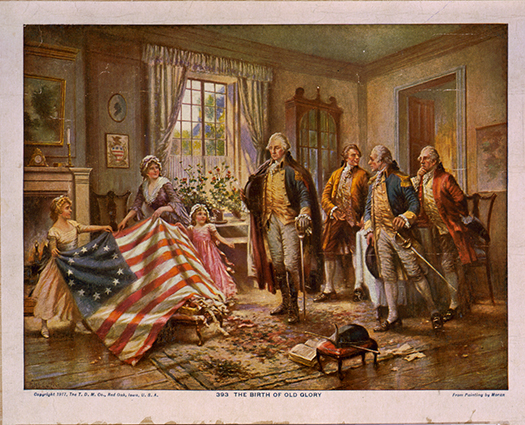
In May 1776, it was not only their shared allegiance to their soon to be nation, but their shared faith that birthed our American flag. Two Episcopalians George Washington and Betsy Ross, who worshiped together at Christ Episcopal Church in Philadelphia, worked with a small and secret committee to design an enduring symbol for our new nation’s future.
The end result was spelled out in the fabric of Old Glory – white stars on a blue background, with alternating stripes of red and white. The stars would grow in number as the states did… from the original 13 to the 50 there now. Blue, the symbol for vigilance, perseverance, justice and freedom. White for purity and innocence. And Red, hardiness, courage, valor and, of course, the price of blood so often paid for the freedom we now enjoy.
God’s blessing of America, like many things God does, is a partnership arrangement.
For those who love our country and all for which it stands, when called to pledge our allegiance – we stand, we remove our hats, we silence our conversation. We place our hands over our hearts and we promise yet again our loyalty – as we should – to the essential intangible qualities of a free land entrusted to our care by God Almighty.
Regardless of the polarizing strains of identity politics that some promote, the vast majority of Americans still hold to the reality that we are “One Nation Under God,” and that, as our Declaration of Independence states, we are “…endowed by our Creator with certain unalienable Rights… among them, Life, Liberty and the pursuit of Happiness.”
Today, many of us will sing in celebration, Irving Berlin’s words, “God Bless America.” But for our time, it might as well be as much of a prayer as it is a patriotic hymn.
A minute or two with the headlines of any newspaper, or the first two minutes of any news channel, are enough to tell us that we need something beyond ourselves to help us. Whatever we are doing on our own, is doing little, if anything to stem the tide of cultural divisiveness, racial disharmony, pervasive political corruption and unceasing violence. We need something beyond ourselves – to help us, to save us – to bless us.
While I offer these words as a Christian pastor, my work alongside religious leaders from all traditions, would agree – that God’s blessing of America, like many things God does, is a partnership arrangement.
Yes, God’s blessings are always initiated with God Himself, but all the great stories of faith offer a deep truth – that much of what God does – is done not just “for” those made in God’s image, but “with” them – alongside them. Abraham, the Father of Hebrews, Christians and Muslims – was promised by God an inheritance, but in order to claim it, he would have to set himself on God’s path – trusting and believing, by faith, that holding God’s hand, he would ultimately receive that promise.
What, today, might help us in that partnership with God? For your consideration — using the flag as a kind of background, let me offer a few suggestions as a 4th of July meditation of sort.
First, let the red in our flag recall for you the word, “Remember.” Remember the price paid for your freedom – from the Alamo to Gettysburg, from Anzio to Korea, Vietnam, the Persian Gulf, Afghanistan and Iraq. Remember, too, those who responded to terrorist attacks within our own borders. It is impossible to really take in the sacrifice of life, limb and loved ones for the cause of freedom, but it is not impossible to be eternally grateful.
Only weeks ago, my wife and I visited Omaha Beach in Normandy. As we walked off the beach, a young couple was laughing as they snapped photos with two of their toddlers – a scene not possible on the same beach that only 79 years before was soaked in the blood of allied soldiers who paved the way, not just for a free Europe, but a free world – and a scene that absolutely would never have been if the launch of D-Day had not turned the tide of that horrible war.
Later, as we gazed upon the over 9,000 graves of Americans buried just above that same beach, no words fit what only the heart could feel – humility and gratitude.
Around our globe, we see the birth pains of nations hoping and praying for what you and I have had for well over 200 years. Remember. Remember the price that has been paid. And remember a price that high is also a treasure impossible to value – except through the gift of grateful remembrance. So – remember.
From Fox News Opinion. A nice reflection and so very true. Read it all.
Independence Day should be more than fireworks and festivities—it should be a day of profound reflection and recognition. A day to honor the tremendous sacrifices and unyielding values of the Founding Fathers and American Patriots who defied death and tyranny, breaking free from the oppressive reign of a despotic king and the British Empire. These intrepid souls, fueled by an unwavering commitment to freedom, epitomized moral courage and selflessness. They challenged staggering odds, inspiring generations. However, a disconcerting chasm now gapes between the spirit of 1776 and today’s dominant values.
Historical accounts tell us that during the American Revolution, less than 45 percent of colonists actively supported independence, according to historian Thomas Slaughter. This reminder underlines that the quest for freedom and justice seldom garners unanimous applause. Often, it’s the morally brave few who defy the status quo, facing mockery, rebuke, and even death.
Sound familiar?
Today, citizens face not a lethal external enemy but an insidious domestic one—”cancel culture.” This modern menace, capable of publicly ostracizing individuals, seems a harsher fate than that faced by our forefathers.
Modern societal norms starkly contrast with the spirit of American independence. We see personal accountability crumble, a government increasingly dismissive of our Constitution and Bill of Rights, a weaponized justice system, and too much of a media landscape that has lost its objectivity.
The Lexington Minuteman Statue superimposed in American flag against blue sky. Lexington Battle Green, Massachusetts. (Photo by H. Armstrong Roberts/ClassicStock/Getty Images)
This amalgamation is a formidable threat to the freedom, justice, and individual liberty our founding fathers fiercely fought for. We must not only acknowledge these challenges but also actively strive to re-instill the founding principles of our nation—personal responsibility, limited government, and the safeguarding of individual rights. The question is: are we willing to change course, regardless of discomfort or inconvenience, or will we let the sacrifices of our ancestors be in vain?
From Fox News. Agree with this opinion, especially with the last question above. Read it all.
For those of you who have ears to hear, listen and understand.
Many different explanations have been proposed for the problems that beset us. While there are undoubtedly multiple causes at work here, what I want to focus on is what I believe to be a fundamental yet neglected factor: the sea change that has taken place in American religious life. As Ross Douthat has observed, a map of America’s religious past, “would look like a vast delta, with tributaries, streams and channels winding in and out… but all of them fed, ultimately, by a central stream, an original current, a place where all the waters start.” That place is “not the orthodoxy of any specific Christian church,” but “the shared theological commitments that have defined the parameters of Christianity since the early church.” For the past half-century, however, that spring “has gradually been drying up,” so much so that we are witnessing “the slow-motion collapse of traditional Christianity” in America.
The transformation of our religious landscape includes: the rapid demographic decline of American Christianity (according to Pew, the percentage of Americans who describe themselves as Christians has declined by 12 percent between 1998 and 2018, and current projections are that within a few decades, less than half of Americans will identify as Christians); the increasing marginalisation of Christians and accelerating de-Christianisation of American culture; the declining importance of religion in the lives of Americans; the rise of the so-called “nones”; the emergence (especially among the young) of a deep-seated scepticism of — and even hostility toward — organised religion; the undisguised contempt of cultural elites towards Christianity; the emergence of religious traditions native to Asia and the Middle East as presences on the American scene; and the rise of what are sometimes called “remixed” religions or do-it-yourself religions. As late as 1931, the Supreme Court could describe Americans as “a Christian people.” Would anyone make that same claim today?
On June 14, 1777, the Continental Congress approved the design of a national flag.
Since 1916, when President Woodrow Wilson issued a presidential proclamation establishing a national Flag Day on June 14, Americans have commemorated the adoption of the Stars and Stripes in many ways–displaying the flag in the front of their homes, parades, and other patriotic observances. Prior to 1916, many localities and a few states had been celebrating the day for years. Congressional legislation designating that date as the national Flag Day was signed into law by President Harry Truman in 1949; the legislation also called upon the president to issue a flag day proclamation every year.
And check out this interesting webpage from History.com for all kinds of info about Flag Day, including tips on how to properly display a flag. Happy Flag Day!
In the United States, June 6, 1944 will receive passing mention on news programs and social channels. There are few, if any, parades or official remembrances. Even those veterans who fought across the beaches and on to Berlin will receive scant recognition for what they did to liberate a continent and preserve the blessings of freedom for those who would follow.
In Normandy, they have not forgotten. They have not forgotten the Nazi occupation nor those who came ashore and dropped from the heavens [79] years ago. There are parades, remembrances, reenactments, parachute drops, and fireworks. The entire region, thousands of people, come out to welcome these heroes of the WW II generation, hug them, kiss them, ask them for photographs and autographs, and listen to their stories, stories they remember as if D-Day were yesterday.
But D-Day was not yesterday. It was [79] years ago. Those who fought there are creeping up on a century of life; some have passed that milestone. Soon they will walk among us no longer, their legacy honored by some, unappreciated by others, forgotten by too many.
The people of Normandy remember what it was like to be invaded and oppressed. And they remember what it was like to be liberated. They pass along the stories and the appreciation. What these men did on June 6, 1944, and in the months that followed will not be forgotten here. It is a privilege to spend time with them on the beaches, fields, and towns in which they fought.
As I push Walter Stowe through the Brittany American Cemetery in his wheelchair, he reminds me that in life we will touch a great many people. The question, he says, is will the people whose lives we touch be the better for it? Wise words.
Remember these citizen soldiers today and every day. Spend time with them at every opportunity. Listen to their stories. Embrace their wisdom. And when the last of them walks among us no longer, honor their sacrifice by standing strong for the freedoms for which they fought.
Remember them.
Read it all and watch President Reagan’s speech from 1984.
Soldiers, Sailors and Airmen of the Allied Expeditionary Force! You are about to embark upon a great crusade, toward which we have striven these many months. The eyes of the world are upon you. The hopes and prayers of liberty loving people everywhere march with you. In company with our brave Allies and brothers in arms on other fronts, you will bring about the destruction of the German war machine, the elimination of Nazi tyranny over the oppressed peoples of Europe, and security for ourselves in a free world.
Your task will not be an easy one. Your enemy is well trained, well equipped and battle hardened, he will fight savagely.
But this is the year 1944! Much has happened since the Nazi triumphs of 1940-41. The United Nations have inflicted upon the Germans great defeats, in open battle, man to man. Our air offensive has seriously reduced their strength in the air and their capacity to wage war on the ground. Our home fronts have given us an overwhelming superiority in weapons and munitions of war, and placed at our disposal great reserves of trained fighting men. The tide has turned! The free men of the world are marching together to victory!
I have full confidence in your courage, devotion to duty and skill in battle. We will accept nothing less than full victory!
Good Luck! And let us all beseech the blessings of Almighty God upon this great and noble undertaking.
— Gen. Dwight D. Eisenhower
(For a fascinating story about what General Eisenhower was saying to his troops in the picture above, click here).
Today marks the 81st anniversary of the beginning of the Battle of Midway (June 4-7, 1942), the decisive turning point in the war against the Japanese during World War II. It was unique in that the opposing navies never fired a direct shot at each other. It was all fought through the air.
Read more about Midway here and check out the video below.
For you history buffs who want the real thing, check out this video below.
I also want to commend to your viewing the 2019 release of the film Midway. It is one of the most compelling, gripping movies I have watched. If you want to see real courage and heroism in play, you won’t be disappointed.
Today marks the 78th anniversary of V-E Day (Victory in Europe Day), May 8, 1945, in which the Allies celebrated the unconditional surrender of Nazi Germany the day before. Take a moment today and thank God for bringing us victory over evil. Remember the brave men and women who fought against Nazism. If you know a veteran who is still alive, take time today and thank him (or her) for his service to our country. Ask that person to tell you his story and remember it so that you can pass it on to your children and others. Nazi Germany may be a thing of the past, but unspeakable evil certainly is not.
With great sorrow at the recent decision of the Church of England’s General Synod to legitimise and incorporate into the Church’s liturgy the blessing of same sex unions, ten Primates of the Global South Fellowship of Anglican Churches (GSFA)[i] met virtually on 13 Feb 2023 under the chairmanship of Archbishop Justin Badi (Chairman of GSFA & Primate of South Sudan) to discuss our response.
The panel of Primates agreed on the following resolutions which it now commends to the orthodox[ii]provinces and dioceses who are part of her Fellowship for the respective Primate & Province to consider and deliberate on.
As the Church of England has departed from the historic faith passed down from the Apostles by this innovation[iii] in the liturgies of the Church and her pastoral practice (contravening her own Canon A5[iv]), she has disqualified herself from leading the Communion as the historic “Mother” Church. Indeed, the Church of England has chosen to break communion with those provinces who remain faithful to the historic biblical faith expressed in the Anglican formularies (the 39 Articles, the Book of Common Prayer, the Ordinal and the Book of Homilies) and applied to the matter of marriage and sexuality in Lambeth Resolution 1.10[v] of the 1998 Lambeth Conference.
As much as the GSFA Primates also want to keep the unity of the visible Church and the fabric of the Anglican Communion, our calling to be ‘a holy remnant’[vi] does not allow us be “in communion” with those provinces that have departed from the historic faith and taken the path of false teaching. This breaks our hearts and we pray for the revisionist provinces to return to ‘the faith once delivered’ (Jude 3) and to us.
The GSFA is no longer able to recognise the present Archbishop of Canterbury, the Rt Hon & Most Revd Justin Welby, as the “first among equals” Leader of the global Communion. He has sadly led his House of Bishops to make the recommendations that undergirded the General Synod Motion on ‘Living in Love & Faith,’ knowing that they run contrary to the faith & order of the orthodox provinces in the Communion whose people constitute the majority in the global flock. We pray that our withdrawal of support for him to lead the whole Communion is received by him as an admonishment in love.
The worldwide Anglican Communion as we know it is dead, but it will be reconstituted and emerge stronger than ever. It is simultaneously heartbreaking and infuriating to see a majority group of bishops in the Church of England vote to violate their consecration vows and abandon the historic Faith once and for all time delivered to the saints, the Faith every bishop vows to defend and teach at his consecration. They are apostate and have chosen to drink the koolaid of the 21st century sexual agenda, an agenda that is utterly opposed to the Christian Faith, an agenda that is disordered and cannot bring about human flourishing as the gospel can, precisely because it is disordered. Humans in their foolishness, pride, and folly may kick at the pricks, but that will never produce real peace and flourishing. May God the Father have mercy on the sin-sick souls of these apostate bishops.
That’s the bad news. The Good News is that Jesus Christ is still Lord and in control of God’s good creation, despite appearances to the contrary. Our Lord himself promised that the gates of Hell will not prevail against his Church and so those of us who remain orthodox Anglican Christians continue to live in hope, even as the Church in the West is in a death spiral. I doubt this is much different from the days when the 4th-century heresy of Arianism seemed to prevail. But it didn’t. Neither will this latest enemy of the Faith prevail. And so we take courage, even in the darkest night. Amen. Come, Lord Jesus!
December 7, 1941, a date that will live in infamy, so said then President Franklin Roosevelt the next day as he asked Congress to declare war on Imperial Japan. It is the day Japan launched a treacherous sneak attack on the United States’ Pacific Fleet docked at Pearl Harbor, resulting in thousands of lives lost and the crippling of our fleet. It also ended our policy of isolationism and signaled the beginning of the end for the fascist and militarist movements in the Axis Powers, although few could see it at that time. Pearl Harbor reminds us we must remain vigilant against our nation’s enemies, both internal and external. Take some time today to remember the men and women who lost their lives that day and give thanks for the Greatest Generation who fought against the Axis Powers. Ask God’s protection on those who serve in the military in our day. Remember, remember the 7th of December, 1941, a date that will live in infamy, 81 years on today.


 In the United States, June 6, 1944 will receive passing mention on news programs and social channels. There are few, if any, parades or official remembrances. Even those veterans who fought across the beaches and on to Berlin will receive scant recognition for what they did to liberate a continent and preserve

You must be logged in to post a comment.